GTM Engineering Is Dominating Tech Spend
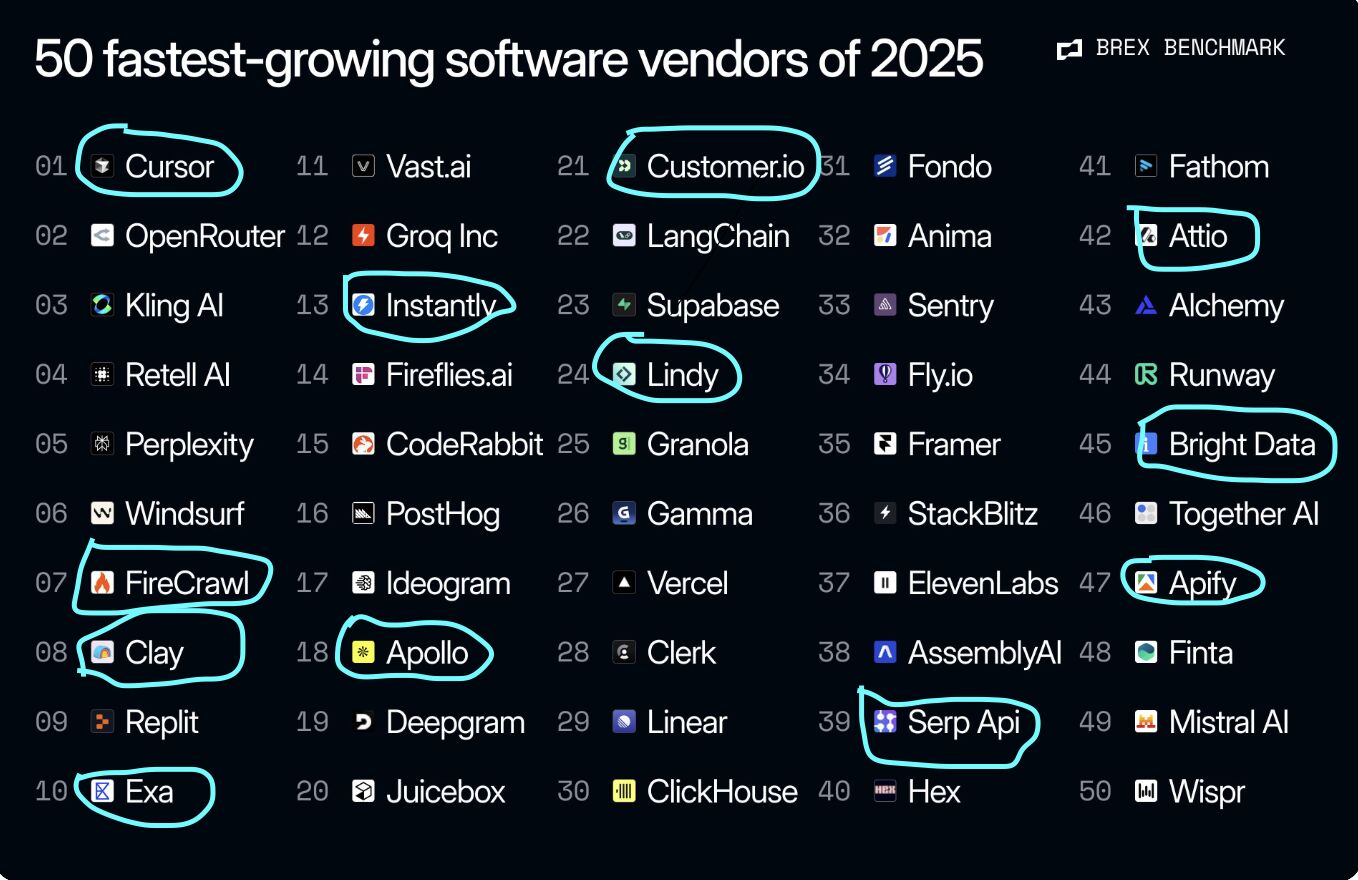
Brex analyzed spend data from 35,000 companies to find which tools exploded last year.
The entire list is basically four categories: AI for coding, GTM engineering, dev tools, and voice AI. That’s it. GTM engineering tools didn’t just make the list — they dominated it.
This is not early adopter behavior anymore. GTM engineering is mainstream B2B infrastructure.
What the Brex Data Actually Shows
When 35,000 companies collectively shift their spend toward a category, that’s not a trend piece for a LinkedIn carousel. That’s a market moving.
The companies on the list aren’t niche startups with 12 customers. These are tools with real revenue growth driven by real teams spending real budget. And the pattern is clear: companies are investing in tools that make their GTM teams faster, more data-driven, and more automated.
Eight of the 26 companies from the Zevenue tech stack made the list. Some of them we’ve been using since their first year. Watching them go from “interesting tool we’re experimenting with” to “fastest-growing in a 35K-company dataset” has been something.
The Four Categories That Own the List
AI Coding Tools
This is the most obvious category. AI-assisted development tools are eating the software engineering workflow. But what’s worth noting for GTM teams: this same shift is coming for you. The same pattern — AI augmenting practitioners, not replacing them — is exactly what’s happening in GTM engineering. The coding tools just got there first.
GTM Engineering
This is the big one. Tools for enrichment, outbound infrastructure, contact discovery, web scraping, and CRM are all over the list. These aren’t “nice to have” tools for early adopters anymore. They’re the standard stack for any B2B team running outbound seriously.
Clay is the most obvious example. A year ago, you’d explain Clay to people and get blank stares. Now it’s one of the fastest-growing B2B tools by spend. The same is true for sending platforms, scraping tools, and enrichment layers.
Dev Tools and Infrastructure
Developer productivity tools continue to grow fast. The connection to GTM engineering is more direct than people realize — many GTM workflows now involve code, APIs, and data pipelines. The line between “dev tool” and “GTM tool” is blurring.
Voice AI
Voice AI tools are growing fast, driven by sales teams automating SDR calls and customer support. This category is earlier than the others, but the spend growth is real.
The Specific Tools and What They Do
Let me break down the GTM-relevant tools from the list, because the specifics matter.
Clay — the enrichment and workflow engine that’s become the backbone of modern outbound. Clay lets you build data pipelines that pull from dozens of sources, enrich prospects with custom signals, and route them into campaigns. If your team is still manually researching prospects in browser tabs, Clay is what replaces that.
Instantly — the email sending platform. It handles mailbox rotation, warmup, and campaign management at scale. This is infrastructure, not optional tooling. If you’re sending outbound from your primary domain through HubSpot sequences, you’re already behind.
Apify — web scraping at scale. When the data you need doesn’t exist in a database, you scrape it. Apify lets you pull structured data from any website. We use it for everything from event attendee lists to company directory pages.
Firecrawl — turns any website into structured, LLM-ready data. This is a newer tool that’s growing fast because it solves a real problem: getting clean, usable data from web pages for AI workflows. If you’re building agent workflows that need to understand web content, Firecrawl is how you feed them.
Exa — AI-native search. Not Google search with an API wrapper. Exa understands semantic queries, which means you can search for “Series A vertical SaaS companies in logistics that recently hired their first VP of Sales” and actually get useful results. This is what makes account research scalable.
Attio — the CRM that’s eating into HubSpot and Salesforce territory for startups. Purpose-built for teams that want flexibility and data model control without the bloat.
These aren’t luxury purchases. They’re the basic infrastructure of a modern GTM operation.
What the Old Playbook Looks Like Now
Here’s the uncomfortable part. If your team is still running the playbook from 2022, this is what you’re competing against:
You’re manually researching accounts. They’re automating it with Clay. A team with a Clay workflow can enrich 5,000 prospects with custom signals — hiring data, tech stack changes, funding events, competitive intelligence — in the time it takes your SDR to research 20 accounts in browser tabs.
You’re sending from HubSpot or a legacy sequencer. They’ve moved to purpose-built sending infrastructure. Deliverability is a technical problem now. Dedicated sending platforms, proper domain rotation, inbox placement monitoring. Teams using legacy tools are landing in spam while their competitors are landing in the primary inbox.
You’re guessing about prospects. They’re scraping competitive intelligence with Firecrawl and Exa. Modern GTM teams know what their prospects’ competitors are doing, what technology they’re using, what roles they’re hiring for, and what their public positioning says — all pulled automatically, all feeding into personalized outreach.
You’re writing one email template with spintax. They’re generating genuinely unique emails at scale. AI-powered copy generation with real enrichment data as input produces emails that are structurally different from each other. Better deliverability, better personalization, better reply rates.
The gap between these two approaches isn’t marginal. It’s an order of magnitude in speed, coverage, and quality. And the Brex data shows that the market has already picked a side.
What This Means If You Haven’t Made the Shift
The window where GTM engineering tools were optional is closing. The Brex data shows that these aren’t emerging tools anymore — they’re standard infrastructure. Your competitors are already using them.
This doesn’t mean you need to adopt every tool on the list tomorrow. But it does mean three things:
First, your outbound infrastructure needs to be purpose-built. Sending cold email through your marketing platform or a legacy sequencer is no longer viable. Deliverability requirements have changed. The tools have changed. If you haven’t invested in dedicated sending infrastructure, start there.
Second, your enrichment and research workflow needs automation. Manual prospect research doesn’t scale, and it can’t compete with teams running automated enrichment pipelines. Clay or something like it needs to be in your stack.
Third, your team needs to think in systems, not campaigns. The teams winning with these tools aren’t running one-off campaigns. They’re building repeatable systems — data flows, enrichment pipelines, scoring models, routing logic — that compound over time. Each experiment makes the next one better.
The Brex data is a snapshot of where the market is right now. By the time the next report comes out, the gap will be wider. The teams that move now will have compounding advantages. The teams that wait will be playing catch-up against an accelerating curve.
GTM engineering is not a trend. It’s the new baseline.