The Problem with AI SDRs
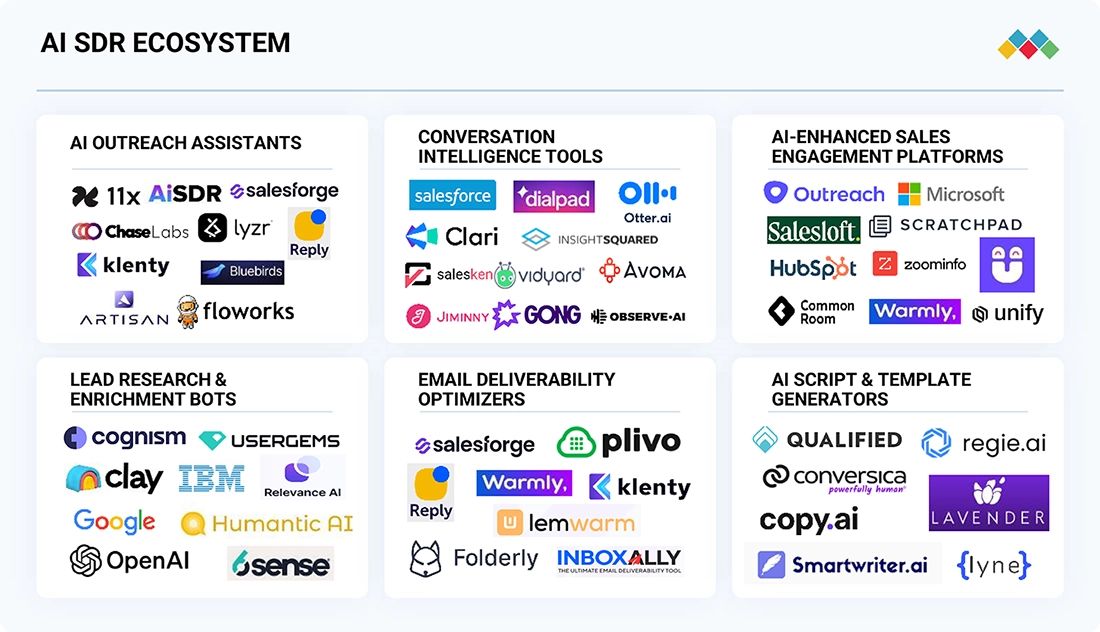
A client told us they were evaluating an AI SDR tool. The pitch was compelling - plug it in, point it at your ICP, and watch it book meetings. Fully autonomous. No ramp time. No headcount.
They asked what I thought.
I told them I’d seen this movie before.
The shelf life problem
Here’s what actually happens. The tool launches. It hits your most obvious prospects - the ones already in buying mode, the ones with the clearest intent signals, the ones who would have replied to almost anything decent. At some point between months 1-3, they run out of surface area.
This isn’t anecdotal. UserGems reported 50-70% annual churn on AI SDR platforms in 2026. 11x - the most funded company in the category at $50M raised and a $350M valuation - reportedly loses 75-90% of new sign-ups within three months. One user documented paying roughly $22,500 over six months for a single lead.
And it’s not just one vendor. 11x, Artisan, AiSDR, Rox AI - the whole category runs into the same wall. Not because the technology is bad, but because they are fighting an impossible fight. The architecture is wrong.
An external tool, by definition, operates on the outside of your business. It knows what you tell it during onboarding. It doesn’t know why you target VPs instead of directors. It doesn’t know that legacy enterprise prospects need a completely different message than Series A startups. It doesn’t know that the deal you closed last quarter came from a throwaway line about compliance in a cold email.
That kind of context is the whole point of agentic workflows in GTM in 2026.
Context as infrastructure
I’ve spent ten years writing cold emails and the last two building GTM systems with code. The single biggest unlock isn’t better copy or better data or better sending tools. It’s context - the accumulated understanding of who you’re selling to, why they care, and what’s worked before.
When that context lives inside your own systems, it compounds. Your outbound team uses it. Your AEs reference it for battlecards. Your marketing team pulls from it for content. Your demo environment reflects it. One investment, multiple returns.
When that context lives inside an external AI SDR tool, it’s locked in a box you don’t own. And when you cancel the subscription - which most teams do within a year - you lose it.
The numbers behind “autonomous”
SaaStr ran a controlled 90-day test comparing fully autonomous AI outbound against a human-AI hybrid approach. The AI-only path booked 847 meetings at an 11% conversion rate. The hybrid - human judgment plus AI execution - booked 312 meetings at 38% conversion. Fewer meetings, 2.3x more revenue.
That ratio tells you everything. The autonomous approach optimizes for volume. The hybrid approach optimizes for signal. Volume is easy to automate. Signal requires context that no external tool can hold for you.
Meanwhile, B2B cold email reply rates have dropped from 6.8% in 2023 to around 4-5% in 2025 as inbox providers got smarter at filtering AI-generated outreach. Gmail’s AI inbox now specifically flags automated messages. The volume play is getting harder, not easier.
The real argument is about plumbing
Think about every piece of tech in your GTM stack right now. Your CRM. Your enrichment tools. Your sending infrastructure. Your analytics. The question you should be asking about each one isn’t “does it have AI features?” It’s “can I connect this to my internal context via API or CLI?”
(This also applies to the rest of the tech stack, not just GTM.)
Teams that are winning at outbound right now aren’t the ones with the best individual tools. They’re the ones who’ve wired their tools together into workflows that reflect how their specific business sells. The enrichment pipeline feeds the scoring model, which feeds the routing logic, which feeds the messaging system - and all of it pulls from a shared context layer that gets smarter with every campaign.
An external AI SDR simply can not fit into that architecture. It sits next to it, doing its own thing.
Build is winning
Two years ago, building custom outbound workflows required engineering resources most startups couldn’t justify. You needed a team of engineers who could write code, understood APIs, and also knew enough about sales to build something useful. That person barely existed. So you would have to assemble a team that could pull all of this off.
Now a single GTM operator with Claude Code can build the same infrastructure in plain English. The cost of “build” has droppped massively in 12 months, while the ceiling of what you can build went up. There’s a reason the GTM engineer role is emerging as the successor to the 10-person SDR team - one builder constructing custom Clay + API + LLM workflows instead of licensing a packaged product (on annual, multi-seat pricing!)
This doesn’t mean you build everything from scratch. You still buy your sending tool, your enrichment APIs, your verification services. But the orchestration layer - the part that decides who gets contacted, with what message, based on which signals, in what sequence - that’s increasingly something you own and build internally.
The vendors know this. Watch how the smart ones are positioning. They’re not selling “AI SDR replaces your team.” They’re selling APIs, integrations, workflows. They’re becoming components, not replacements.
The tradeoff is real
Someone on your team has to set this up. They need to understand your sales process well enough to encode it into workflows. They need to maintain it, iterate on it, improve it as you learn what works. This is also where we step in, to bridge the gap for B2B companies building an AI-native GTM function that they can own.
But consider the alternative. The real total cost of an AI SDR tool runs $35-65K per year once you factor in setup, oversight, and the 15-20 hours per week of human babysitting these tools actually require. It burns through your best prospects in the first quarter. When it stalls, you have nothing to show for it - no system, no context layer, no compound learning. So the real cost is prospect reputaiton, burned time (and run rate), and the fact that you have taken zero steps to building your own AI-native system.
Smarter teams are investing that same budget into building an internal system. It’s slower in week one. But by month three, you have workflows that reflect your actual sales motion, a context layer that keeps getting richer, and infrastructure your whole team benefits from - not just outbound.
The quiet shift
Gartner predicts 40% of agentic AI projects will be canceled by end of 2027. The GTM AI Podcast called it “the AI SDR bubble popping” - and compared the cycle to outsourced call centers in 2004 and marketing automation in 2012. Big promises, fast adoption, slow disillusionment.
But the most effective outbound we’ve seen in 2026 isn’t autonomous at all. It’s human judgment that is encoded into workflows. Your team’s knowledge, made executable.
The gap between “we have AI” and “AI works for us” is context. And context, by definition, has to come from inside.
I don’t think AI SDR tools are useless, for the record. They can even succeed in certain markets. I do think they’re the wrong solution for most teams, especially because of what you can build for yourselves and how well it can serve your entire GTM org for years to come.
Header image from MarketsandMarkets.