Applied AI in Your GTM Team
Ask a GTM team today whether they use AI and the answer is always yes. Press on what that means and it usually comes down to a few people with a chat window open, pasting in emails to rewrite and calls to summarize.
That’s real. It’s also the bottom rung of something much taller.
The teams pulling away right now aren’t the ones with access to better models. Everyone has the same models. They’re the ones who have climbed higher up the ladder of what AI can actually do inside a revenue org. Applied AI is the difference between a team that dabbles and a team where AI quietly runs parts of the system. It helps to be specific about what that ladder looks like, because where your team sits on it decides what you get out of it.
This builds on work by Kyle Norton, who broke down the four levels of an AI-native team and, at his own company, centralized applied AI inside one expert group instead of scattering it across the org. What follows is our own three-level cut of the same idea.
The three levels
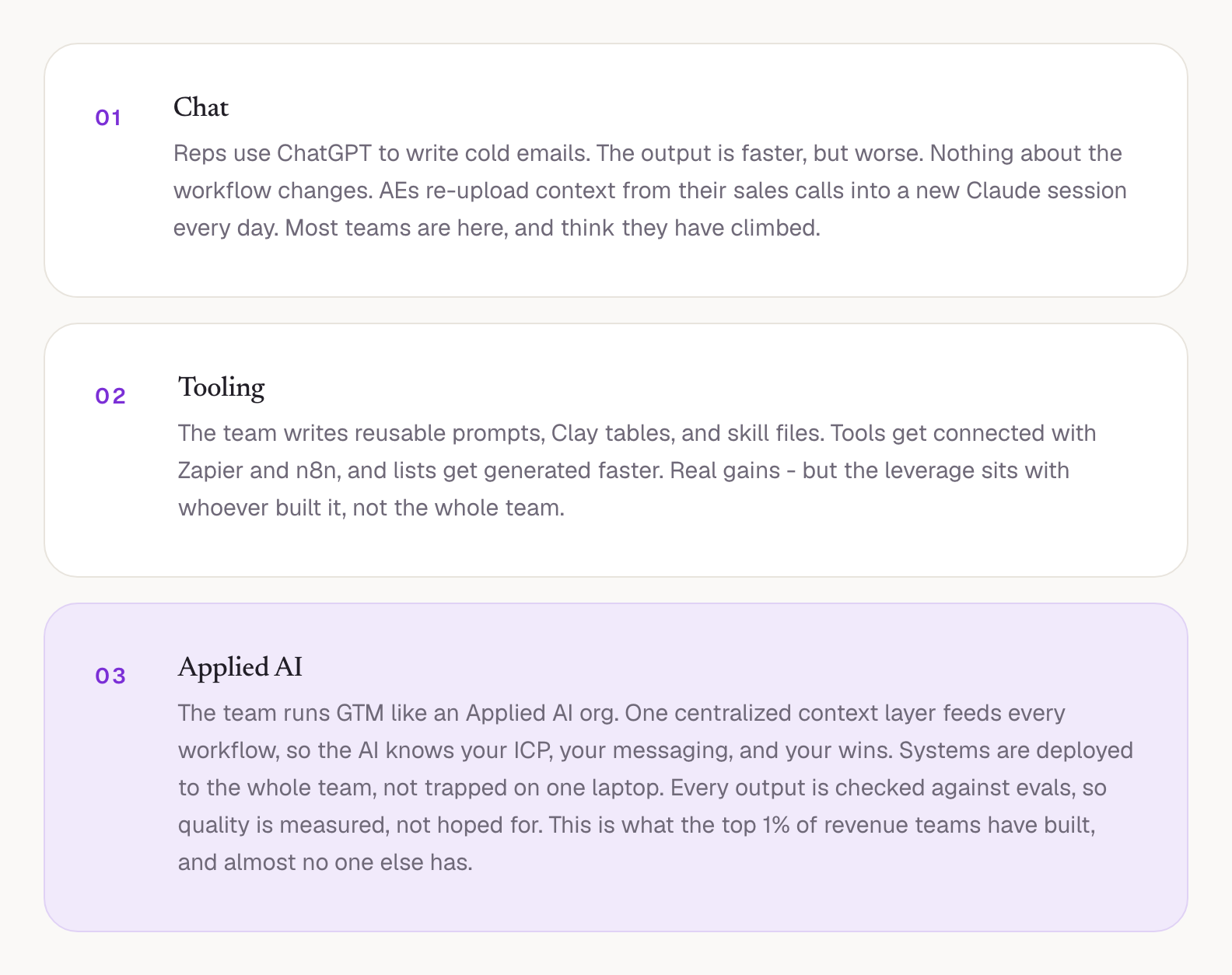
Level one: chat. Someone opens ChatGPT or Claude and prompts it by hand. Rewrite this email. Summarize this call. Draft a follow-up. The output is only as good as whoever is typing, nothing is saved, and nothing compounds - an AE re-uploads the same context into a fresh session every morning. Useful, but it lives and dies with individual effort. Most teams are here, and think they have climbed.
Level two: tooling. The team starts building - reusable prompts, Clay tables, skill files, a few things wired together with Zapier or n8n. Lists get built faster, prompts get shared, real work gets automated. These are real gains. But the leverage sits with whoever built it, not the whole team. When that person is heads-down or the workflow breaks, everyone else is back at a chat window. This is where most teams that take AI seriously top out. It feels like a destination. It is actually the middle of three.
Level three: applied AI. The team runs GTM like an applied AI org. One centralized context layer feeds every workflow, so the AI knows your ICP, your messaging, and your wins without anyone re-uploading them. The systems are deployed to the whole team, not trapped on one laptop - reps, AEs, marketing, and ops all draw on the same engine in plain language. And every output is checked against evals, so quality is measured across thousands of cases instead of eyeballed one at a time. At this level AI owns whole steps of the funnel - research, scoring, call review, first-draft outreach - and you can prove it is working because you are measuring it. This is what the top 1% of revenue teams have built, and almost no one reaches it by accident.
Why most teams stall
The jump from level two to level three is enormous, and it widens every quarter as the ceiling rises.
The reason teams get stuck is simple: each level up demands something the one below it did not. Climbing from chat to tooling is easy - anyone can build a Clay table or a clever prompt. Climbing from tooling to applied AI is a different kind of work. It means turning a pile of individual tools into one centralized system the whole team runs, with shared context underneath it and evals that prove it works. That is a real gap in capability, not a line in a budget. Handing every rep a chat window - or even a folder of prompts - does not move a team up the ladder. It gets you a building full of people each running their own slightly different setup, none of it compounding.
This is the trap inside “we gave everyone AI.” Access was never the constraint. Capability is. A decentralized free-for-all rarely climbs past tooling, because the top of this ladder is not a tool you switch on. It is a function you have to build - built by a few, run by everyone.
What “applied” actually means
The highest-value AI in a GTM team is usually invisible to the customer.
The flashy version - autonomous agents blasting personalized cold email at scale - is the lowest-value use of all this, and the one most likely to embarrass you. The real gains are internal and unglamorous. Enriching records that no database sells. Scoring which accounts deserve a human’s time. Reviewing every call and surfacing the moments a manager should hear. Coaching at a scale no manager could match by hand.
None of it works on a weak foundation. AI is a pattern machine. Feed it broken data and disorganized process and you get broken output faster. So the foundation comes first - clean data, defined process - and the AI sits on top of it, aimed at a narrow job. Give a model a tight, well-defined task and it is reliable. Give it a blank canvas with too much room to roam and it starts making things up. Constraint is a feature, not a limitation.
Where this leaves you
The point of mapping the levels is not to rank teams. It is to make the ceiling visible.
Most revenue teams are operating a level or two below what is already possible, and the gap is not budget or tool access. It is that nobody has built the higher rungs yet. The teams winning with AI did not buy something the others could not. They turned applied AI into a function and climbed.
The tools will keep getting easier, and the rungs that need an engineer today will move within reach of a sharp operator tomorrow. But the ladder is not going away. The only question worth asking about your own team is which rung it is standing on, and what it would take to climb one more.