Introducing Headless GTM
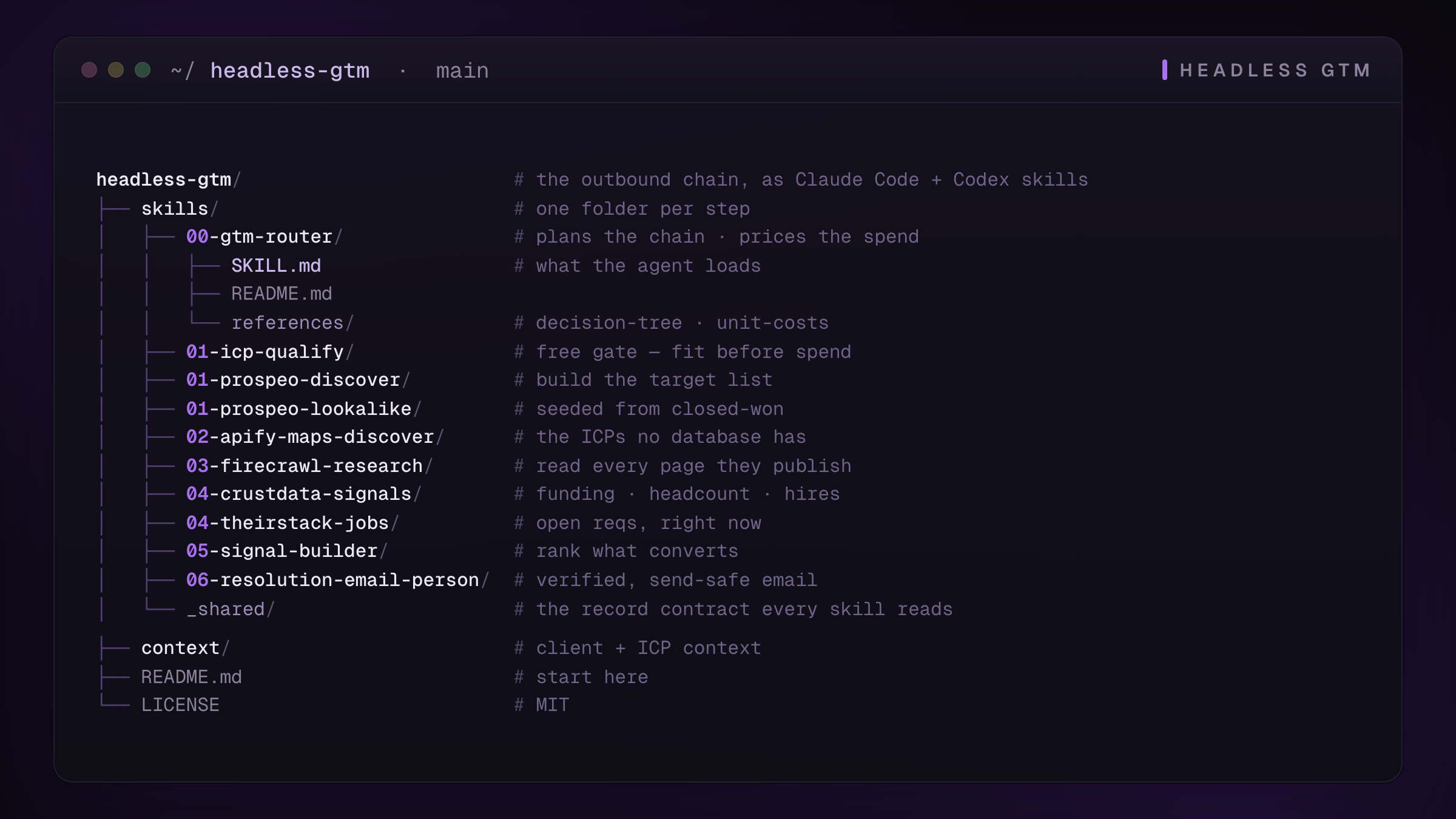
We built a better GTM repo. In it, we are giving away our GTM stack - and the judgement behind our outreach.
It’s called Headless GTM. The repo is live, and it’s the full outbound chain - discovery, enrichment, signal scoring, email resolution - packaged as skills that run inside Claude Code or Codex on raw vendor APIs.
Why now
Three reasons, and a practitioner can price out all three.
- Enrichment is extremely cheap. The data that used to justify a platform subscription is now a cheap API call.
- GTM is moving from dashboards to research agents. The work is shifting from clicking through tabs to briefing an agent that does the run for you.
- Every GTM repo out there needs rebuilding - ours included. The new models need far less hand-holding, and the wrappers written six months ago don’t take advantage of that.
What you’re actually paying for
Every GTM tool you pay for gives you three things: data, a workflow, and a UI. Your favorite enrichment tool is a database with a search page. Strip the search page and you have an API and some rows.
Once you start running GTM inside a coding agent, that UI stops being the product. But handing an agent your API keys doesn’t make it a complete stack either. Keys plus prompts get you a demo, not a system.
So what we’re shipping is the two things that are actually hard: the chain, and the judgement.
The chain
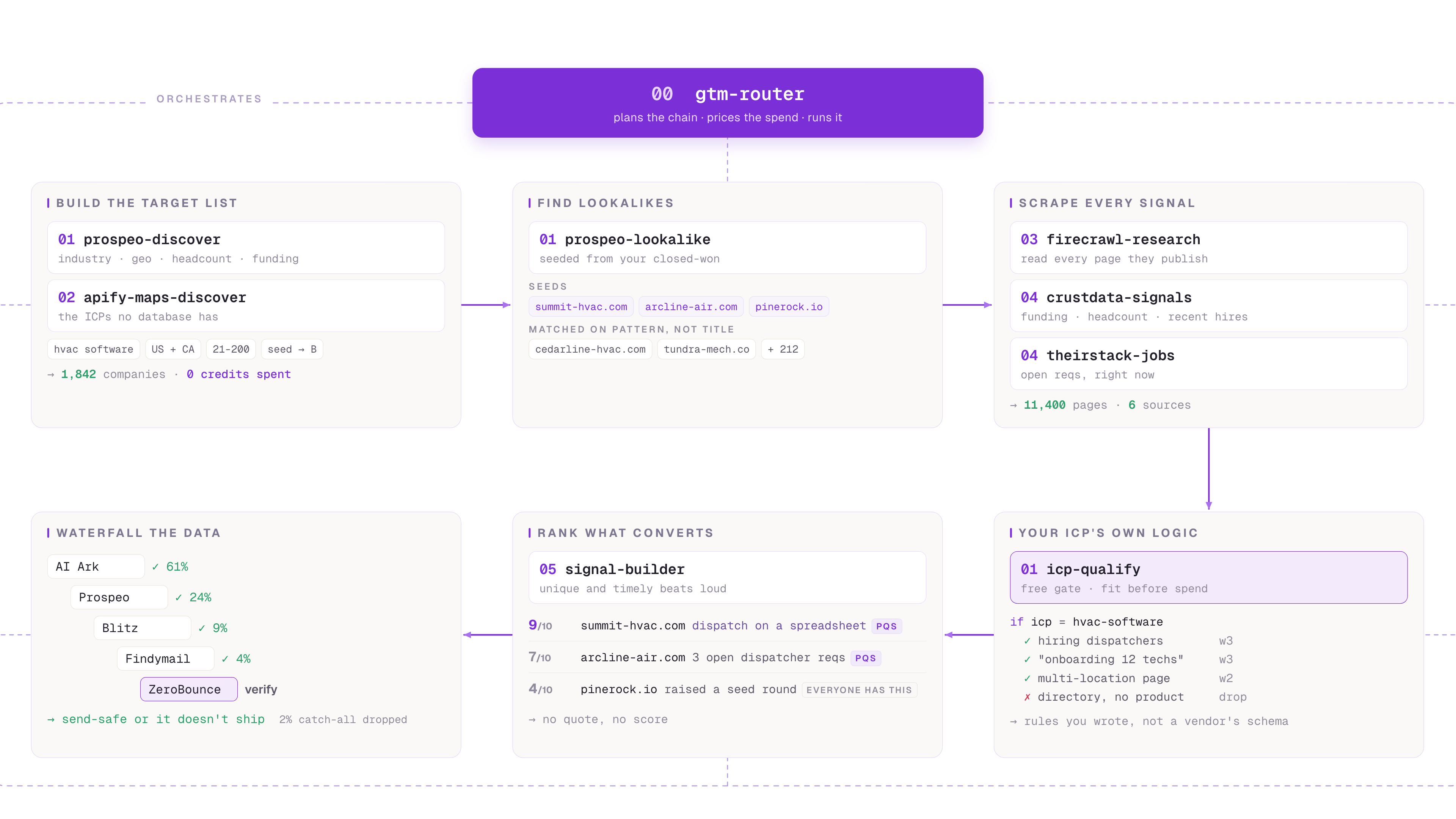
Build the target-market list. Find lookalikes of your best accounts. Scrape the web for any relevant signal you can find. Run our own logic for the custom signals that matter depending on who your ICP is. Then a layer that decides which signals are actually unique and likely to convert. Then a waterfall that finds and verifies the email you’re looking for. All without ever leaving your agent.
The judgement
This is the part a wrapper skips. If you’re running GTM in Claude Code or Codex, you should be able to answer:
- Am I paying to enrich companies that were never going to buy?
- How do I reach people in my target market that I can’t find in a title-based database?
- If the agent returns 500 companies, which 40 do I email first - and what’s the signal that proves it?
- What is this list going to cost me, before I spend a dollar?
A repo that’s just keys and prompts can’t answer those. The chain can. That’s the judgement layer: the qualification gate that says no before you spend, the scoring that ranks by evidence instead of vibes, the router that prices the whole run up front.
Rebuilt for the new models, and actually tested
We rebuilt everything to work with newer, more capable models that need less hand-holding. And we tested it - with and without Headless GTM. You can see the difference in the outputs.
Why “headless”
E-commerce made this move already. They got rid of the storefront, kept the backend, and called it headless. This is the same thing for GTM. Keep the data vendors. The agent is the interface now.
Headless GTM runs on the vendors we already trust - Firecrawl for extraction, Prospeo for discovery, Apify for local-market data, CrustData and TheirStack for signals, Findymail for verified emails.
The repo: github.com/Zevenue/headless-gtm
Watch the announcement: https://youtu.be/N9TfSdz-U3I?si=CxS8AIQx2i3uMKWO